Managed Farmland vs. Traditional Land Investment: Which Builds Better Long-Term Wealth?
"Land has always been considered one of the safest and most rewarding investments in India. But not all land investments are created equal. Today, investors are choosing between two very different paths: buying raw agricultural land and taking on all the work themselves, or investing in fully managed farmland that comes with plantation development, maintenance, and long-term support built in. If you're evaluating where to put your money for the next 10-15 years, understanding"
What Is Traditional Land Investment?
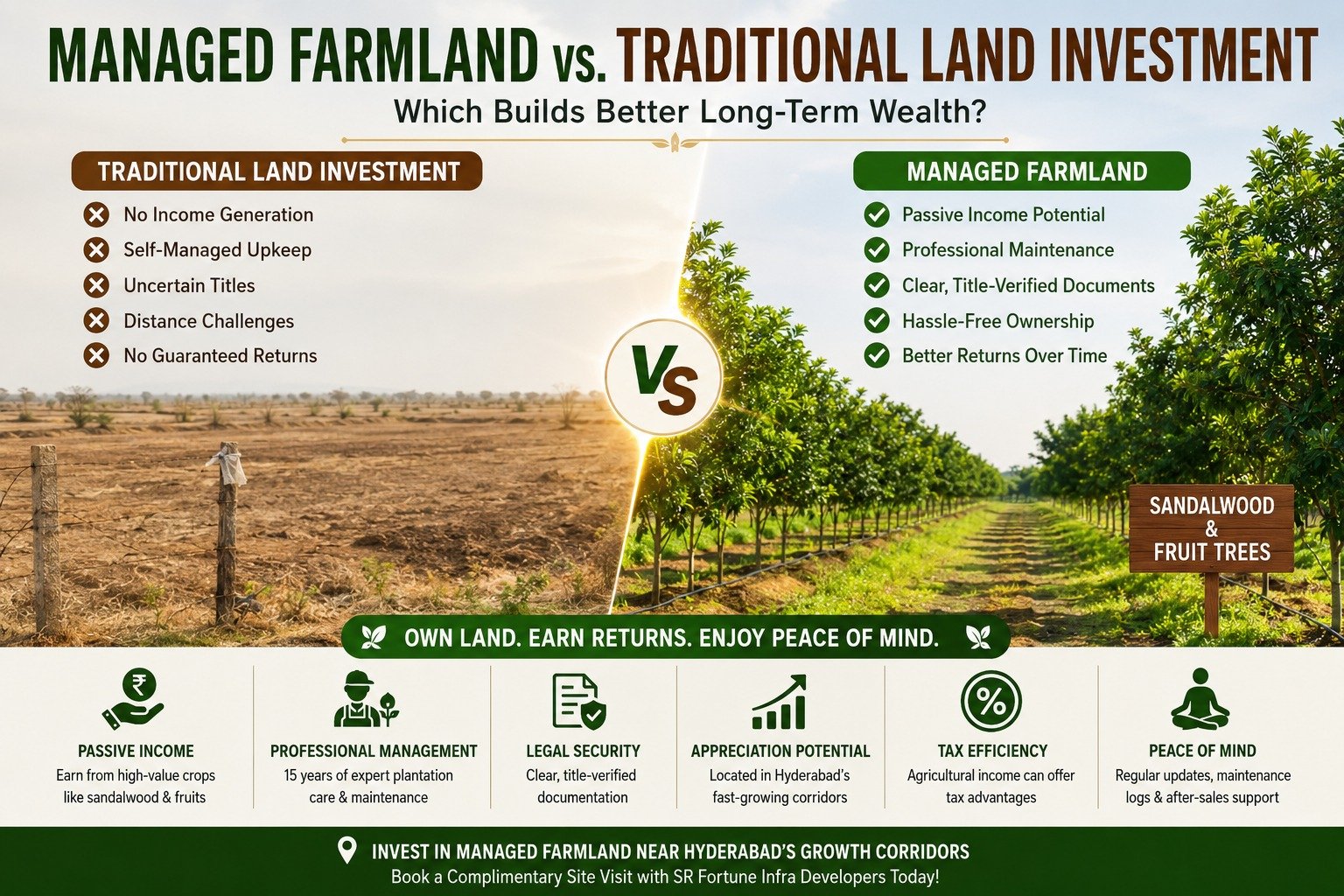
Traditional land investment typically means purchasing raw agricultural or vacant land and either leaving it untouched or attempting to develop and maintain it yourself. This route often sounds simple on paper, but in practice it comes with several hidden challenges:
- No cultivation or income generation — the land simply sits idle, waiting for price appreciation.
- Self-managed upkeep — clearing, fencing, irrigation, and security become the owner's personal responsibility.
- Uncertain titles — many raw land parcels come with incomplete documentation, disputed boundaries, or unclear ownership history.
- Distance challenges — investors who don't live near the land struggle to monitor or maintain it.
- No guaranteed returns — appreciation depends entirely on the surrounding area developing, with no passive income in the meantime.
For investors without agricultural expertise or the time to manage a property from a distance, raw land can quickly become a passive liability rather than a passive asset.
What Is Managed Farmland?
Managed farmland flips this model. Instead of buying empty land and hoping for the best, investors purchase a plot that is developed, planted, and maintained by professional agricultural teams — often for a fixed period, such as 15 years.
At SR Fortune Infra Developers, our Farmland Community in the Zaheerabad corridor is a good example of how this works. Each acre is developed with:
- 170 Sandalwood trees — a long-term, high-value crop known for its appreciating market price.
- 170 Fruit trees — offering an additional layer of agricultural yield.
- 15 years of professional maintenance — covering irrigation, plantation care, and land upkeep.
- Clear, title-verified documentation — reducing legal risk for the investor.
This means investors don't need farming knowledge, don't need to relocate, and don't need to worry about day-to-day upkeep. The land is productive from day one, and the appreciation potential is backed by both the growing crop value and the location's real estate growth.
Comparing the Two: Key Factors for Long-Term Wealth
1. Passive Income Potential
Traditional land offers no income until it is sold. Managed farmland, on the other hand, is planted with high-value trees like sandalwood, which can generate meaningful returns over a 10-15 year horizon — creating an asset that works for you while you wait for it to appreciate.
2. Maintenance and Effort
Raw land demands ongoing personal attention — fencing, weeding, monitoring encroachment, and security. Managed farmland comes with a dedicated maintenance team handling all of this, making it a genuinely passive investment.
3. Legal Safety
Raw agricultural land purchases can be riddled with title disputes, unclear succession records, or missing documentation. Reputable managed farmland projects provide title-verified land with comprehensive historical documentation reports, significantly reducing legal risk.
4. Location and Growth Corridor Advantage
Land value is ultimately about location. Managed farmland projects positioned within Hyderabad's expanding growth corridors — close to industrial hubs, tech clusters, and highway networks like NH44 and NH65 — benefit from both agricultural yield and real estate appreciation simultaneously.
5. Tax Efficiency
Income generated through agricultural activities, such as sandalwood and fruit cultivation, can benefit from agricultural tax provisions, making managed farmland a cleaner and more tax-efficient wealth-building tool compared to purely speculative land holding.
6. Peace of Mind
Perhaps the biggest difference is peace of mind. With managed farmland, investors receive regular updates, maintenance logs, and after-sales support — rather than wondering whether their land is being encroached upon or neglected.
Which One Builds Better Long-Term Wealth?
For investors who have the time, local presence, and expertise to actively manage raw land, traditional land investment can still work — but it requires significant hands-on involvement and carries higher legal and maintenance risk.
For most investors — especially those living outside the immediate area, working professionals, or first-time land buyers — managed farmland offers a far more secure, structured, and genuinely passive path to long-term wealth. It combines the fundamental value of land ownership with the added benefits of agricultural income, professional upkeep, and legal transparency.
Final Thoughts
Building long-term wealth through land isn't just about buying at the right price — it's about choosing an investment you can trust to grow, both literally and financially, without constant intervention. Managed farmland developments, like those offered across Hyderabad's Zaheerabad and Shadnagar corridors, are designed precisely for this purpose: combining nature, income, and appreciation into one secure asset class.
Ready to explore a managed farmland investment near Hyderabad's growth corridors?
Book a complimentary site visit with SR Fortune Infra Developers and see the difference professional land management makes.
Interested in land investment?
Schedule a personal consultation and site visit to Zaheerabad or Shadnagar corridors.